A Maui Treasure: The Dunes at Maui Lani
Golfweek's No. 2 course on Maui and one of Golf Digest's five best-kept secrets in America.
From the Autumn/Winter 2006 issue of the Maui Golf Review
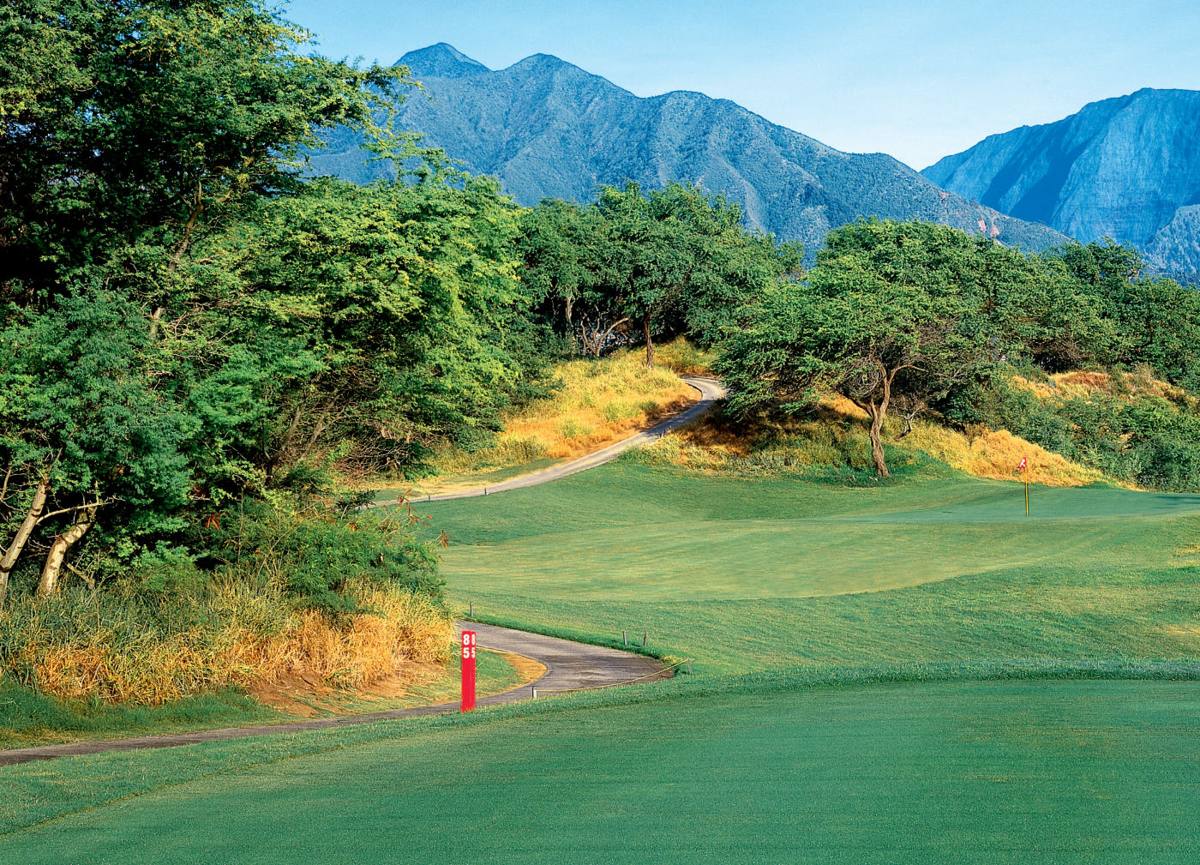
According to the Hawaii Department of Land and Natural Resources, they include “the brackish Kanaha Pond State Wildlife Sanctuary and Kealia Pond on the south coast of Maui....”
By all measures, the only thing keeping this rare part of the world’s unique dunes land from being “officially classified” by the USGA as a links (see About links), is the fact that it is not located in Scotland!
Well, that’s their call, but we nonetheless regard it to be genuine and authentic linksland in every way except climate.
This is the site of the renowned Dunes at Maui Lani Golf Course. And, while settlers over the past two centuries have cultivated much of the surrounding land, the site where The Dunes lies
remains untouched—an unspoiled place where ancient Hawaiian alluvial sand dunes exist—that is, until Maui Lani was created.
“I remember when I first saw it,” course architect Robin Nelson said of the land on which The Dunes is built. “You’re lucky if you get one of these sites in a lifetime.”
“My vision,” he said, “was to create an Irish links-style course in concept, keeping in mind that it would be unique because the grasses and humidity factors in Hawaii are totally different than those found in the British isles.”
Nelson’s design of The Dunes uses the terrain with great imagination and restraint. The result is a rare Hawaiian links with both character and charm. A course unlike any other: “The Dunes site is as close to an authentic links as can be built in Hawaii,” he adds.
Robin’s philosophy was simple: “I wanted to follow the contours of the land,” he said. “It related to other basically courses I have done in that manner, such as The Dragon (the Sierra Nevada layout whose ‘Dragon’s Gate’, the 390-yard, par 4 12th, was named among the three ‘Great Golf Holes’ of California, USGA Golf Journal, 1995-2000.
The others named by the Journal being: the 9th hole at Poppy Ridge, Livermore and the 18th hole at Pebble Beach, and Ravenwood, in New York; ranked the third most difficult public course in New York State).
“In each case, where we didn't move much dirt to create the cou7ate the design. This was even more the case with The Dunes,” he notes.
Nelson’s use of the terrain and
The bunkers on the old links courses are mostly revetted, or sod-walled. These bunkers have an upright wall made of sections of sod. While Robin Nelson designed The Dunes to have these revetted bunkers, it was local resident and golf course builder John Byrne (pictured left) who oversaw their construction. The effort was well worth it, as their steep embankments are quite dramatic. Interestingly, every bunker on the Old Course at St. Andrews is a revetted bunker.
The sand in their bunkers comes off the course’s West Sands beach—shell and all. The Dunes at Maui Lani’s bunkers feature sand that was harvested on site too. Fortunately, there are no shells to contend with in these bunkers, but the sand is very fine, which takes a bit of practice to master. • the wind follows a key architectural tenet that has withstood the test of time: that nature provides the most enduring challenge. He didn’t invent this approach, but he was certainly one of the few visionaries in his field who, the more he studied the past, could see the future.
Therein lies Nelson’s gift—the principal reason why he is among the great golf course architects of this era.
Ron Whitten, the preeminent golf course architecture editor at Golf Digest, wrote this of Nelson in his review of Ravenwood: his “traditional, timeless ideas [will not] allow our minds to wander,” adding that Robin is “one of those veteran American architects who According to the USGA: “‘Links’ is a term that refers to a very specific geographic land form found in Scotland. Such tracts of low-lying, seaside land are characteristically sandy, treeless, and undulating, often with lines of dunes or dune ridges, and covered by bent grass and gorse.
To be a true links, the tract of land must lie near the mouth of a river—that is, in an estuarine environment. From the Middle Ages onward, linkslands (generally speaking, poor land for farming) were common grounds used for sports, including archery, bowls and golf. Because many of the early courses of Scotland were built on these common linksland, golf courses and links have forever been associated. The term ‘links’ is commonly misapplied to refer to any golf course.
But remember that a true links depends only on geography.” is better known overseas than at home.”
Whitten quickly points out why golfers here in the United States are in for a treat when Robin’s new, bold American courses (and there are a bunch on the way) open: “He [Robin] did one of the world's great seaside venues at Mangilao on Guam and one of the world's loveliest at Bali in Indonesia.”
Ron Whitten and Golf Digest backed up their words of praise by instantly recognizing Robin’s first East Coast layout as the No. 5 "Best New Public Course" in America when it opened in 2003. (This is in addition to the long list of accolades bestowed on The Dunes since it opened in 1999.) But awards and accolades mean only so much. It’s the golf itself that is what counts.
“I play to a 10-handicap,” Nelson explains. “So although I’m usually looking down the middle of the fairway, my eyes are always darting to the rough. This helped me a lot in designing The Dunes to be enjoyable for both the pro and the average golfer alike,” he said.
“I never intend holes to be birdie or bogey holes. I try to create
strategic risk/reward values are higher on some holes than they are on othholes—where ers,” he declares.
“For example, on hole No. 2 [a 381-yard par 4], if the tee shot carries the bunkers on the right, the second shot is not blind from the berm long of the landing area on the left.
“On No. 4 [the 509-yard par 5],“ he adds, “it is more obvious: the perfect tee shot rewards the possibility of going for the green in two.”
“On the [362-yard par 4] 5th, the longer the tee shot, the easier the second, but longer gets increasingly more difficult.”
Robin’s focus on player strategy is consistent throughout the round: “On the [547-yard par 5] 9th,” he points out, “the tee shot is wide open, and the challenge is on the second shot. The pot bunkers in the middle of the fairway are bigger than they look, so it appears that the golfer can easily carry them to set up an easy pitch to the elevated green. However, because of the scale of the bunkers and the background of the hill and the blind green, depth perception is skewed, and those bunkers come into play a lot more than one may think.”
Robin drives his point home on No. 12: “The tendency,” he says, “is to hit as long a tee shot as possible, but the best shot is to lay back on the top of the hill. There is a trick to each hole, and the more you play, the more you learn,” he confides.
In the tradition of the classic links courses of old, the front nine heads out, and the back nine heads in. According to Nelson, “Anyone who has seen Ballybunion, Royal County Down, or Shinnecock Hills will recognize a similar look and feel at The Dunes at Maui Lani.”
In their August 2004 “Secrets Issue,” The Dunes was listed as one of the “five best-kept secret golf courses in America” by Golf Digest. The number-one monthly golf magazine in the world went on to say that The Dunes: is the “best of two worlds: a tropicalparadise layout in an Irish dunes setting.”
In sum, make sure you play this