Seaside Sanctuary: The Makena Golf Club
Quick-Track Par: 72 | YDS: 7014-6630-6112-5489 | Rating/Slope: 73.8/137 Mapto MakenaG.C. • PG 176 Hole No. 10 on the South Course at Makena features t…
From the Spring/Summer 2008 issue of the Maui Golf Review
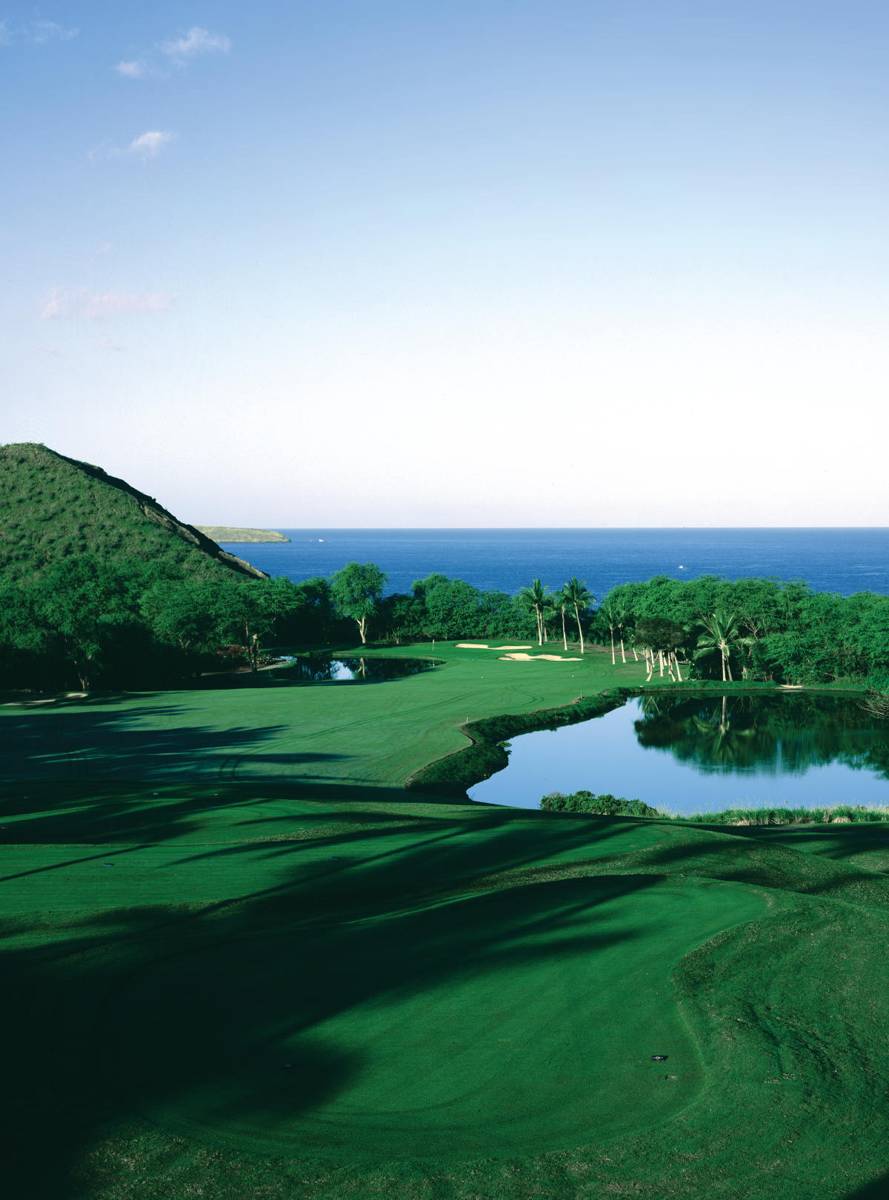
Quick-Track Par: 72 | YDS: 7014-6630-6112-5489 | Rating/Slope: 73.8/137 Mapto MakenaG.C. • PG 176 Hole No. 10 on the South Course at Makena features two lakes and an oblong green. But what really makes this hole stand out are the views. Be sure to grab your camera and catch a shot of you and your group on this famous tee—considered one of Hawaii’s top par 5s. Yardage: 514 | 489 | 468 | 449 Par: 5 Handicap: 4 “When I think of the South Course,” Scott Bridges, golf operations manager at Makena tells us, “the holes that really stand out in my mind are just about every one of them!”
I press him to expand. “Well of course, the par 4 4th, with the pond fronting the green and Molokini in the distance, that is a striking golf hole. But I also think the views of Haleakala are stunning on the par 4 6th too, the well-known pro who has worked on Maui and the Big Island for years tells me.
Of course, the South has the only oceanside golf holes on this side of the island, and I’d say that is another thing that makes Makena so special,” he adds. The par 3 fifteenth, and the par 4 16th have you starting right at the ocean, and the No. 16 green is literally surrounded by water,” the affable golf professional intimates.
The 7,014-yard, par 72 South Course at Makena has a slope rating of 138 but is actually a half-shot stronger than its counterpart to the North. Like Scott said, it is the only course in South Maui with golf holes that are situated right along the oceanfront. Waves crashing into the lava outcroppings along the left side of the 16th fairway inspired NBC golf analyst, Mark Rolfing, to describe the South as “seaside golf in Hawaii at its absolute very best.”
While the two ocean holes at Makena South do indeed mark an unforgettable crescendo, the South’s other 16 holes, carved out of lava, and surrounded by kiawe forestry, are equally spectacular; they all point straight at some kind of view—whether it is the ocean, Mt. Haleakala, or some landmark, like Molokini.
Robert Trent Jones, Jr. used the sea, the foothills, the terrain, and the distant views to create a compelling golf challenge that takes full advantage of the raw beauty of this resort’s dramatic land and panoramic views of the sea.
“You ride down these fairways,” says Kirk Nelson, the Makena head pro and winner of He owns South Maui. Robert Trent Jones, Jr. has made his mark around the world, in Hawaii, and especially on Maui. No other course architect has as many courses that bear his name as does Mr. Jones. He describes Makena as one of the most “beautiful and natural settings” for a golf course that you will find anywhere.
While scenic, Makena’s North and South Courses are among Maui’s most challenging, too. tournaments for about the past four decades, “and you see wili wili trees, lush forests, spectacular views, the sun shining every day of the year—and then you have this great layout—the South Course is tough to beat.”
Mark Rolfing echoes Nelson’s sentiments. “My favorite hole on the South is No. 10, a truly great risk/reward par 5. The view here is spectacular and the shot values high,” he said. “No. 10 is a terrific start to a great back nine. You may be tempted to go for the green in two, but remember, par is always a good score....”
As mentioned, Jones uses water, land, and Molokini as backdrops on all of the South’s holes. The par 4, No. 4 hole exemplifies Jones’ work. Here, the crescent-shaped submerged volcano, Molokini, looms in the distance behind the green, which is fronted by a large pond. The green looks like an island, set between the sea and a fresh-water pond. Once you’re standing over your ball in the fairway on No. 4, you’ll know what I mean! Like Mark says, “The shot value is high,” but don’t forget to capture this hole on film!
Like its sister, the North Course, the South weaves through the slopes of Haleakala. Its changes in elevation are a result of deft hole routing by Jones, who keeps things out of the stratosphere and uses more subtle elevation changes instead.
The 15th is a “wonderfully deceptive par 3,” Mark says of the first of Makena’s two seaside holes. “The tee is elevated considerably from the green, which makes it appear like it is almost sitting in the ocean. Choosing the correct club is very important but difficult here because the green is very wide but not very deep,” he added.
“Mark is right about No. 10,” Scott adds. “It is truly one of Hawaii’s finest par 5s.”
The 188 yard par 3 15th, on the South, plays with a strong right-toleft trade wind and O.B. lurking left, so play for the fat of the green on the scenic, seaside beauty. This is a great hole to get a group photo on, so don’t forget to break out that camera and snap a few shots. Yardage: 188 | 180 | 167 | 146 Par: 3 Handicap: 16 WHERE TO PLAY The Makena North Course “is one of the best mountain course layouts in Hawaii,” golf analyst Mark Rolfing explains.
“Robert Trent Jones, Jr. has taken the slopes of Haleakala and blended them into a wonderful design of golf holes. This course has the best views on this side of the island and at the same time offers a great test of golf.”
The 6,914-yard, par 72 North Course was carved out of lava in 1993 and is a rugged, natural test of golf that winds up, down, and around the verdant slopes of Haleakala. The first 14 holes climb to elevations as high as 800 feet above sea level. The Makena North Course makes the golfer feel at peace with nature and commands incredible panoramic views of the south shore.
Holes on the North Course route around and through ancient Hawaiian rock walls, massive gullies and gulches, streambeds, and lava flows. It is a rugged, true test of golf, where placement of tee shots makes all the difference.
The North Course’s U.S.G.A. slope rating is 139 (from the back or Championship tees). Its narrow fairways, terrain, and undulating, slippery greens keep even the best players on their toes. “I really like the 6th hole on the North Course because it offers you two options off of the tee,” Scott explains. If you go for the left side of the gulch, you open up the hole for the best shot at getting it close. If you play it safe on the right side of the gulch, you’ll find the approach shot is much more difficult.” Looking back from the 6th tee, there's a clear view of the nearby islands of Kahoolawe and Molokini.
The 177-yard 7th is a stunning par 3. “This hole once again shows off not only the ocean, but the West Maui mountains too,” Scott points out. “It has a large lava ravine that crosses the fairway just in front of the green, and while you are thinking about your shot, the island of Lanai also looms in the distance—it’s spectacular!”
The 185-yard, par 3 12th features Molokini as its backdrop and has a large lava ravine that runs from tee to green all the way along the right side. Bunkers along the left side of the green leave you just one safe shot: the middle!
Between No. 12 and the final par 3 on the North is the 620-yard, par 5 14th. Here begins a descent downward in dramatic fashion. Regarded as the North Course’s signature hole, though many holes qualify, it is a monster that features a 200-foot drop from tee to green. Spiced with lots of jungle, flowering plants, trees and lava rock fields to gobble errant shots, it is a great birdie opportunity, reachable only with two perfectly struck shots.
The last par 3 on the North Course is the No. 15 hole, measuring 217 yards. While it plays downhill, two bunkers guard the left and right sides of the green, and the panoramic view of the ocean and Molokini behind the green are sure to distract you.
“I’d have to say we have the most tranquil, naturally stunning golf course of any I can think of here in the islands,” Scott adds. “If someone wants to really get away from it all, and play some golf that is as challenging as it is fair, then the North and South Courses are good bets,” Scott said. And we have to agree.