Makena Beach & Golf Resort: By the Numbers
Makena stands out among Hawai‘i's top golf resorts for a multitude of reasons, but most will agree that its combination of course layout, conditions, …
Maui Golf Review, Autumn/Winter 2009–2010 · Vol. XV, No. 2
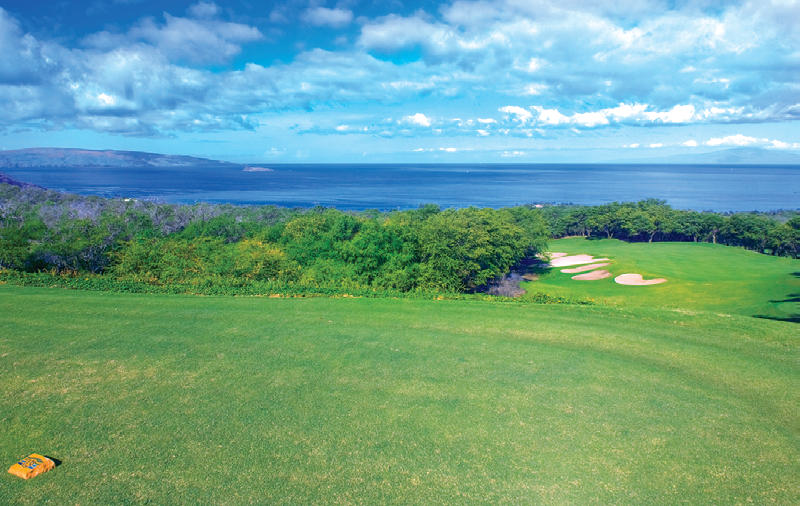
Makena stands out among Hawai‘i's top golf resorts for a multitude of reasons, but most will agree that its combination of course layout, conditions, views, and location, are tough to beat—anywhere.
Situated along Maui's southwestern shore is this Robert Trent Jones, Jr. classic. A modern design, the course boasts dramatic views of a seemingly endless Pacifi c ocean, while it weaves its way over lava fl ows and through an unspoiled kiawe forest. It is a one-of-a-kind course, in a rare setting.
Routed along the rugged, rolling coast at the base of Maui’s 10,028-foot dormant volcano, Haleakalā, Makena golf course is a formidable test, where good tee shots beget equally good approaches, and where putting skills are plied on the truest greens. It is a stage, where golfers perform acts of heroism before an audience of Hawai‘ian coots, red-crested cardinals, and spotted doves.
T e course begins and ends at the clubhouse, with a traditional nine-out, nine-in routing. T e opening holes roll over hilly terrain, playing up and down small valleys, where its verdant fairways weave among huge ravines, lava outcroppings, and ancient Hawai‘ian rock walls. T en the course begins its ascent upward, starting on the 5th hole, toward higher ground, where commanding views await.
On the way, golfers encounter natural hazards which are well-integrated into the Jones design. One example is the par 4 sixth, which features a split fairway with a massive gulch running down its center. To the lef is a long carry to a small strip of fairway as its landing area —but it also opens up the green to attack. T e right off ers a safe route, with an approach angle that off ers fewer options. It is a risk/reward hole in the classic sense; a theme that recurs throughout the round.
T e inspiring vistas that Makena is famous for are fully unveiled on the 11th fairway, where the green appears perched on the edge of the world. No. 12 is equally spectacular, with a 185-yard carry to a green formed along the ledge of a cliff . A huge, rocky ravine guards its front, and the ‘Alalākeiki Channel—with Architect: Robert Trent Jones, Jr.
~ Golf Operations Manager: Erik W. Johnson, PGA ~ Course Superintendent: Oswaldo Cardenas Tee Times/Pro Shop: (808) 891-4000 ~ Fax: (808) 874-0250 ~ E-mail: ejohnson@benchmarkmanagement.com ~ Website: makenagolf.com Makena's USGA course and slope rating, from its back (Tournament) tees, is 73.6/138, which ranks as the third most-challenging course on Maui.
From its middle (Tournament) tees, it ranks as our most challenging, with a slope rating of 135. The Forward tees play an average of 89.5-yards shorter per hole. From the Tournament tees, the average Makena par 5 is 564-yards, just four-yards short of the No. 1-ranked Kapalua Plantation course (568). The average par 4 is 390-yards, and the average par 3, from the back tees, is 199-yards. M
Hole 10 • Par 5 • YDS/550/529/487/431 Molokini fl oating out in the distance —serves as its backdrop, instilling a sense of wonder, and striking a momentary chord of fear, as you ponder your shot. Fortunately, there is a safeplay lef —a bail-out of sorts—to allow for the possibility of an errant shot.
T is just serves to highlight Makena’s abundant shot-making options that give golfers a chance to pick and choose their battles, and allow for many opportunities to make (or break) those career moments.
Take the 14th, a 620-yard downhill par 5 that drops 200-feet in elevation from tee-togreen. Once you fi nish posing in front of that camera, with the amazing views out in the distance, you'll face a tee shot that looks like it may sail forever—toward a wide, dog-legged fairway—and it will! From there, you can play a tricky lay up, or go for it in two? Your second will travel farther than it measures, but no matter what choice you make, the possibility of playing one of those career shots still exists.
As you continue your journey inward, you'll see the west Maui mountains, and Lāna‘i toward its lef . You'll see Kaho‘olawe’s sheer cliff s, and Pu‘u Ola‘i, which in Hawai‘ian means “earthquake hill,” along the shore.
You'll also see Molokini poised directly over the green on No. 15, the 217-yard par 3—yet another example of how Jones highlights distant landmarks and views during the round.
T e fi nishing holes—all par 4s—hug the slope, which comes from the lef , and two feature greens set high on the ridge. All three have wide fairways and big greens, and beckon you to play your best shots heading in.
Yes, there are a couple of tougher golf courses on Maui (the USGA rates Makena as having the third highest slope rating from its Tournament tees). But ratings and statistics of en underlie what we see and feel when we are actually playing, and in Makena's case, it is telling how much this golf course is a true challenge.
Makena Golf Course separates itself from the fi eld by way of its location, and its design. Its natural setting is unmatched, and its fairways rarely intersect. Development here is completly non-existent, and it all combines to impart a feeling of isolation and intimacy. Location and design: Makena's prescription for a truly memorable golf experience.
GOLF Magazine—Silver Medal Resort GOLF Magazine—Top 15 Course You Can Play in Hawai‘i Golf Digest—Top 10 Course in Hawai‘i Golf Digest—4½ Star Rating GOLFWEEK—Top 100 Resort Course While staying recently at the Makena Beach & Golf Resort, Jones spoke of Makena: it is "one of my favorite courses,” he began. “Modern architects come out of school and ignore the land.
I’m a natural architect. Here we did what I call the ‘natural school of routing’,” he said. “We had the pāhoehoe [smooth lava] and ‘a ‘ā [rough lava], so we lef the land as it was and made the routing actually follow—tossing and tumbling,” Jones explained. “T en we veneered the land with cinder, and the grass fi nally took hold. T e nature of it is the beauty of the experience.
You’re like a hiker going through nature,” he said. “We want to retain that. We don’t want to Trumpize that, or make waterfalls. Nothing artifi cial—it should be natural.” GOLFWEEK—Top 15 Public Course in Hawai‘i GOLFWEEK—Top 15 Public Course in Hawai‘i Condé Nast Traveler—Top Golf Resort in US Golf Inc.—Green Award