The Wonder of Wailea
For most of us, golf is a game of highs and lows, in which the best players are good because of their consistency. T ere’s no mystique or aura hanging…
From the Summer/Fall 2011 issue of the Maui Golf Review
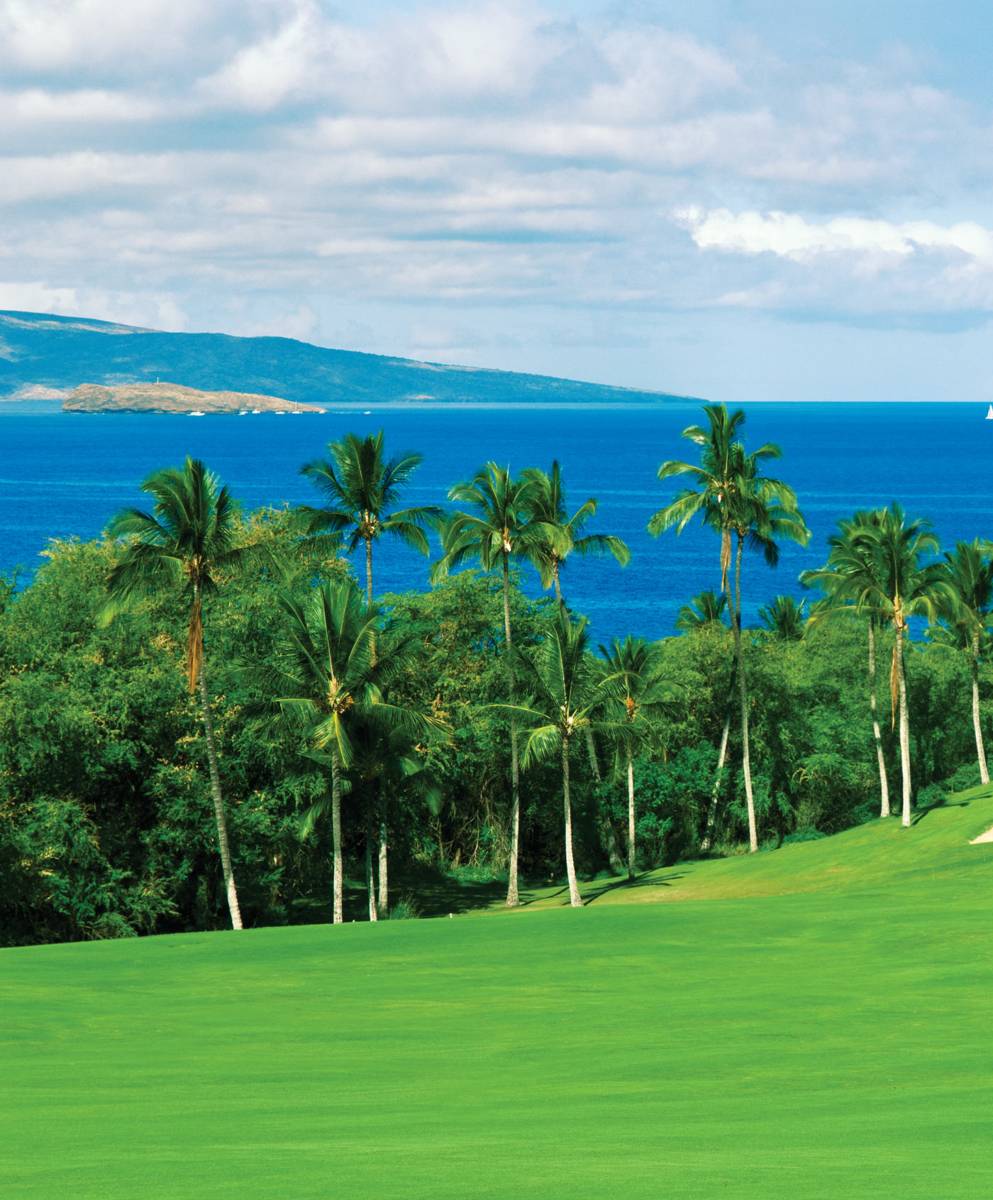
For most of us, golf is a game of highs and lows, in which the best players are good because of their consistency. T ere’s no mystique or aura hanging over them—they just work at it and have natural gif s. T ey make the best of what they’ve got, day in and day out. In a sense, the same could be said about the golf courses here: Most have their share of peaks and valleys, and a rarefi ed few are consistently good. Wailea is one of the latter. If you were to compare it to a golfer, it would be one of the best who ever played.
But before you can experience any of it, you fi rst need to get there. One of Maui’s most famous residents, NBC/Golf Channel analyst Mark Rolfi ng, notes that “Wailea is about 15 miles south of Kapalua as the crow fl ies…”. If you’re not that kind of birdie, never fear, because all roads lead to Wailea. T ere are two main arteries leading to Maui’s version of Rodeo Drive, also known as Wailea Alanui.
Coming from the airport, or West Maui, the Piilani Highway skips past isle homes, and when it ends, you know you’ve arrived…it just oozes swank! T e same holds true if you’re cruising in from the seaside ‘burg’ of Kihei. T is bustling coastal hot spot’s main drag also funnels directly into Wailea, with one caveat: you actually have to make a turn… to the right.
The right way to begin: Après golf at Wailea…
It’s hard to explain in simple terms the wonder of one’s fi rst impression of Wailea. Golf Digest’s Ron Whitten tries: “T e state’s most idyllic setting could be Maui’s ‘golf coast’, the southwestern slope of Mount Haleakala,” he exclaims. “Yet palms, plumeria, and kiawe trees fl ourish. T e scenery is downright decadent....”
Others of less renown describe their initial impressions of Wailea with similarly unabashed praise. A perusal of tripadvisor.com’s more fl attering reviews of the resort unearths remarks from many, such as reets54, who said of Hawaii’s golf mecca: “From the moment I pulled up to the amazing clubhouse I was blown away. I’ve now been to Maui 3 times and have had a chance to play the Gold and Emerald courses a few times.
T e conditioning is world-class (not surprising that the pros like Arnold Palmer and Jack Nicklaus love it there) and the views are unbeatable. You can see Molokini out in the ocean from many of the holes. T e service is top-notch, and the golf shop has the most amazing selection of golf clothing! T is is one of my favourite courses in the world.” f But what is it about Wailea that garners such praise an and induces those who play there, like yelp.com reviewer er jenk k of Norwalk, CA, to say: “Best golf experience to date!”? And: “…worth every single penny and then some.
Shoot, I might just send them another check cuz it was such a great experience.”
In order to cut through all the glitz and marketing-speak, we have to look at the resort in the simplest of terms. For instance, there is its location. As Whitten notes, “Sheltered from the elements, this area receives just 10 inches of rain a year, so sunshine is king.”
What else? How ’bout design? Wailea’s two premiere courses, the Gold and Emerald, are among Robert Trent Jones II’s favorites. He describes them as the “true jewels that lend sparkle to this world class, award-winning 1,500- acre resort.”
T e Wailea Gold and Emerald Courses have been consistently hailed by both golfers and the national media since opening in 1994. T e awards are endless, but it’s worth noting that the accolades include: Golf Digest’s 100 Greatest Public Courses; Golfweek’s Best Courses You Can Play; and Golf Magazine’s Gold Medal for Premiere Golf Resorts, to name just a few.
But there are certainly diff erences between the duo. T e Gold is what Jones describes as the “24-carat option.” Condè Nast Traveler lauds the 7,078-yard former site of the Wendy’s Champions Skins Game as “one of the world’s best-designed golf courses.” T e Gold Course “blends classic design with rugged natural topography, including 200-f elevation changes. Low lava rock walls, tall native grasses, 93 bunkers, and strategically placed doglegs add to the challenge,” Jones explains.
But the real measure is how paying customers feel. Here's what Steven M. from Denver, CO said in his yelp.com review of the Gold Course: “Very beautiful and very challenging course, plays pretty long. In pristine condition, and the staff is extremely friendly.” Or Jimmy p of Cherry Hill, NJ, writing on the same site: “Views were amazing, and each hole required you to think about your next shot. Can’t wait to go back and play another 18!”
I once asked Jack Nicklaus what he thought of the Gold, and he looked at me in astonishment and replied: “What’s not to like?” Jack Nicklaus and Arnold Palmer are the true standouts among the many legends of golf who played the Gold during most of the last decade, but we can’t forget Gary Player, Tom Watson, Lee Trevino, and Fuzzy Zoeller, to name just a few of the other luminaries to build upon the mystique and wonder of Wailea’s championship venue, the Gold.
Travel + Leisure sums up the Gold in its article, “Maui’s Next Shot,” by saying: “the Gold most closely hews to one’s preconceptions of what Hawaiian golf will be,” adding that “T e Pacifi c views are showstopping, the course maintenance is top24-carat option: notch, the hedges are groomed to bonsai perfection, and the ancient lava rock walls, called papohaku, are a delightful fl ourish. Your cart fl ushes birds at every turn, sending chubby francolins and slender egrets scurrying.” Need I say more?
Not to be outshone by all the bling of the Gold Course is her sister, the Emerald, whose cut is just as multifaceted. While Mark Rolfi ng notes that Wailea’s “climate is totally diff erent, a bit more arid,” what stands as an ironic twist is just how verdant and lush the Emerald actually is in terms of its aesthetics.
“…stretching to 6,825 yards, (the Emerald) has many facets, including a sensuousness created by a lush tropical landscape full of plumeria, wiliwili, birds of paradise, fi recracker plants, and other island fl ora,” its designer Robert Trent Jones II explains.
Condè Nast Traveler tops even Jones’ claims: “T at doesn’t do justice to its subtle charms, from its shared tenth and seventeenth green to the postage-stamp thirteenth that evokes the eighth at Pebble Beach to the brilliant fl owers that add to the course’s palette of blue and green. (T e fl ora directional bunkers, this is a course where you should match or beat your handicap but with just enough hazard to feel good about doing it.”
While Golf for Women magazine always ranked the Emerald as one of the most women-friendly resort courses, Jones concedes: “T e course is fl exible and forgiving, with four to six tee boxes on every hole and few forced carries.” But he then defends Old Man Par by noting that the Emerald has plenty of bite too: “T e sixth green falls sharply into grass bunkers, leaving a tricky approach. Number eleven, the longest hole on the course, plays directly into the wind.”
T ere’s little doubt that Robert Trent Jones II hit a home run with the Wailea Emerald Course. It is eye candy from the get-go, and fun for every type of player. Eric R from Brookline, MA in his tripadvisor.com review, vindicates the claims by saying the Emerald has: “…beautiful landscaping: dark black lava, bright greens, and tremendous colors and fauna here are the prettiest of any course an on the island.) With funneling fairways and on Fashionably green… of local fl owers.
T e views of the ocean, lanai, et al were fantastic…” In terms of playability, yet another unbiased tripadvisor.com reviewer, SeattlePH, said: “T e course is more forgiving than the Makena course, and it’s probably the most beautiful course I’ve ever played on.” Need I say more?
T e of -used cliché, ‘the grass is always greener’ is à propos when it comes to Wailea Golf Club. It rests at the foothills of the Ulupalakua Ranch, where in ancient times Hawaiians lived on the slopes of Haleakala mauka of Wailea, where they grew sweet potatoes and ventured down to the shore to fi sh. Legend has it the Hawaiian goddess of canoe builders, Lea, transformed into the beautiful ‘elepaio (a forest bird) and would fl y over the shoreline of this extraordinary coast. T e area became known as Wailea, the “Waters of Lea.”
T e wonder of Wailea awaits you. Paradise found...