Rolling Dunes: The Hidden Gem of Maui
CHAMPIONSHIP aui has a rich golfing history, and the choices vary from two courses—built nearly 100 years ago—to daily fee and resort golf that can se…
Maui Golf Review, 2018 · Vol. XXIII
CHAMPIONSHIP aui has a rich golfing history, and the choices vary from two courses—built nearly 100 years ago—to daily fee and resort golf that can set you back for as little as $65.00, and as much as $300.00 a round per person. The choices are many, and each option has its own plusses, minuses, character, and appeal. The ultimate decision rests with each player’s own preferences, and were you to ask us to recommend the best golf course for you, you’d get a variety of answers, as every golf course has something for everyone and can be measured by degrees.
All golf course operators will claim they stand out from the pack, and they each do in ways, but in this article, we shall focus on a special course, set in the middle of the Kahului isthmus. Few isle residents and visitors know how much of a bona fide, true-blue attraction it really is!
It’s called The Dunes at Maui Lani golf course, and while local golfers know it well, primarily due to its exacting challenges and the wounds inflicted on their prides, most homegrown players are unaware of what makes The Dunes at Maui Lani golf so different. I intend to remedy that void of information here!
Long before the game of golf was even a figment of man’s imagination, nature itself worked its magic on what we now call the Valley Isle, shaping and honing and erupting it from deep beneath the ocean floor, as the Pacific tectonic plate slowly drifted northwest over a stationary hotspot, creating the Hawaiian-Emperor seamount chain. In time, the Hawaiian islands as we know them today, and more specifically, the valley island of Maui, were born.
Back then, the briny sea covered the central plain that’s now used to grow sugar cane, and to motor between the North shore, Maalaea, Kihei/Wailea, and West Maui. This area, between the West Maui mountains and Haleakala, is the Kahului isthmus, which was formed when lava from the emerging Haleakala pooled against the old mountains of West Maui, and over the course of thousands of years, as glaciers grew in other parts of the world and sea levels dropped, broad stretches of coral reef were exposed and broken down into sand.
Trade winds blew the sand on this isthmus, forming ridges, which became lithified, or turned into stone, when carbonic acid was released from the roots of plants growing in the sand. The Valley Isle of Maui came to be, with its sand dunes and rock formations as building blocks.
Birds of all kinds, caught in high circling winds, were hurtled from the continents onto this remote place and so introduced life, from remnants of seeds and flora that were unintentionally carried upon their feathery backs. Deep sea creatures would migrate, with each changing season, to mate. These new islands may have become a midway resting place, where smaller forms of life clinging to these creatures’ bodies would release themselves and take hold of the warm coral reefs where they could flourish.
The islands evolved into an abundance of flora and wildlife. Eventually, Tahitian sea explorers discovered and occupied these fertile lands and settled, becoming Hawaiians and organizing their ahupua’a systems, and forming distinct and unique traditions.
The once-untouched Central Maui sand dunes would eventually be leveled, over but a few centuries, first by Hawaiian settlers and growers, and then later by sugar cane farming; a natural by-product of ambition.
Yet, even to this very day, there exist preserved sections of that original dune land. Tucked away between the Maui Lani Parkway and the plantation increments and new subdivisions largely housing the generations of immigrant families that farmed the Kahului crop lands lies the subject of this story: The Dunes at Maui Lani golf course; a remnant, one could say, of a bygone era.
Designed by the late, great, legendary golf course designer Robin Nelson, The Dunes at Maui Lani golf course rests on Central Maui’s few remaining ancient sand dunes. Its 18 verdant green golf holes spared the ancient sand dunes and, if anything, serve as a sort of historic reserve, thanks to the savvy of Maui Lani developer Bill Mills, who made good use of this vacant and untouched land by creating a crown jewel golf course, right in the middle of his new master-planned community.
Devoid of the massive, cliché-like earth-moving trickery so common in today’s typical modern golf course architecture, The Dunes at Maui Lani’s construction and design were coincidentally minimalist, and thanks to Mr. Mills’s wise decision to hire a course designer well-versed with our island lands, was an unexpected masterpiece that only he, and his designer, Robin Nelson, envisioned.
“I remember when I first saw it,” Robin said, of The Dunes at Maui Lani golf course’s site. “You’re lucky if you get one of these in a lifetime, and I was like a kid at Christmas, rushing from present to present,” the late veteran designer once revealed. “Developer Bill Mills probably thought I was over the top. But when I explained that we could build the best course in Hawaii…he became giddy too.”
Robin Nelson used what nature left to extract the very best and worst out of a given player’s game—no matter what their skill level might be. It was that self-discipline, and the need to incorporate historic archaeological sites, that left the lay of the land as it was, resulting in 18 golf holes of Dunes at Maui Lani golf that are unique in their traits, not only because of the land’s preservation, but in how the two made a golf course of it all.
Robin Nelson, whose designs, refurbishes, and redesigns in Hawaii are the stuff of legend, was wellknown as the most experienced golf course designer—in terms of knowing the lay of our island’s lands, and by virtue of the sheer number of holes he built— of all the other greats whose work is to be found in the Sandwich isles.
Robin’s island golf course designs are evident everywhere, including the Mauna Lani North and South courses on the Big Island; Coral Creek, Royal Kunia, Ewa Beach International, Bay View, West Lock, and the Mid-Pac and Oahu Country Clubs, on Oahu; the Royal Kaanapali and Kaanapali Kai courses, Kapalua’s Bay course, Wailea’s Blue course, and Kahili, on Maui, and Puakea Golf Course, on Kauai.
The design of The Dunes at Maui Lani golf course’s holes themselves was an evolution, of sorts, of Nelson’s repertoire, as his work was far from limited to Hawaii alone, and his experience in life and golf matured. “I wanted to follow the contours of the land,” he said to me in one of our many conversations that took place over the years. “It related to other courses I had done in that manner, such as The Dragon (the Sierra Nevada layout whose “Dragon’s Gate,” the 390-yard, par 4 12th, was named among the three ‘Great Golf Holes’ of California, by the USGA Golf Journal, from 1995-2000).
Others named by the Golf Journal included the likes of the 9th hole at Poppy Ridge, the 18th hole at Pebble Beach, and another Robin Nelson design: the Ravenwood, in Rochester, N.Y.; which was ranked the third most difficult public course in New York State by Golf Digest.
In referring to The Dragon and The Ravenwood, Robin explained: “In each case, we didn’t move much dirt to create the design. This was even more the case with The Dunes.”
Nelson’s use of The Dunes terrain, and the isle trade winds, followed a key architectural tenet that has always withstood the test of time: allow nature to provide the fundamental challenge. The planetary alignment was somehow uncannily perfect for The Dunes when it was built in 1997.
Robin didn’t invent this time-tested approach; he just perfected it. He was among the few contemporaries in his field who—the more they studied the past—could see the future. Therein lay Nelson’s wisdom, and this is the principal reason why his legacy will endure, not only in Hawaii but back on the mainland, and even more so in Oceania and Asia, where his many golf course design accomplishments are highly revered; especially by those in the know, like Ron Whitten, the pre-eminent golf course architecture editor from Golf Digest.
Ron wrote this of Robin Nelson in his review of the design work he did for The Ravenwood: Nelson’s “traditional, timeless ideas allow our minds to wander,” adding that Robin was “one of those veteran American architects who is better known overseas than at home.”
Whitten quickly pointed out why golfers are in for a treat whenever given an opportunity to experience Robin’s brand of bold design: “He did one of the world’s great seaside venues at Mangilao on Guam and one of the world’s loveliest at Bali in Indonesia.”
Ron Whitten and Golf Digest backed up their words of praise for Robin Nelson by instantly recognizing his first Northeastern mainland layout as the No. 5 “Best New Public Course” in America when The Ravenwood opened in 2003. A year later, in their August 2004 “Secrets Issue,” Golf Digest would rank The Dunes at Maui Lani as one of the “five best-kept secret golf courses in America.” The world’s top golf magazine went on to describe The Dunes as the “best of two worlds: a tropical-paradise layout in an Irish dunes setting.” Golf Magazine, Travel + Leisure Golf, Golfweek, and a dozen other international and domestic golf periodicals conjured up their own words of praise for the Central Maui course when it first opened in 1998.
GolfWeek ranked it among Hawaii’s top 10, and in Travel + Leisure Golf’s November/December issue that year, the publication ran a rare two-page photo spread showcasing The Dunes with a caption reading: “Maui Wowie! Even among the great tracks of Maui,” the Condé Nast golf publication noted, “this one has already earned its place.”
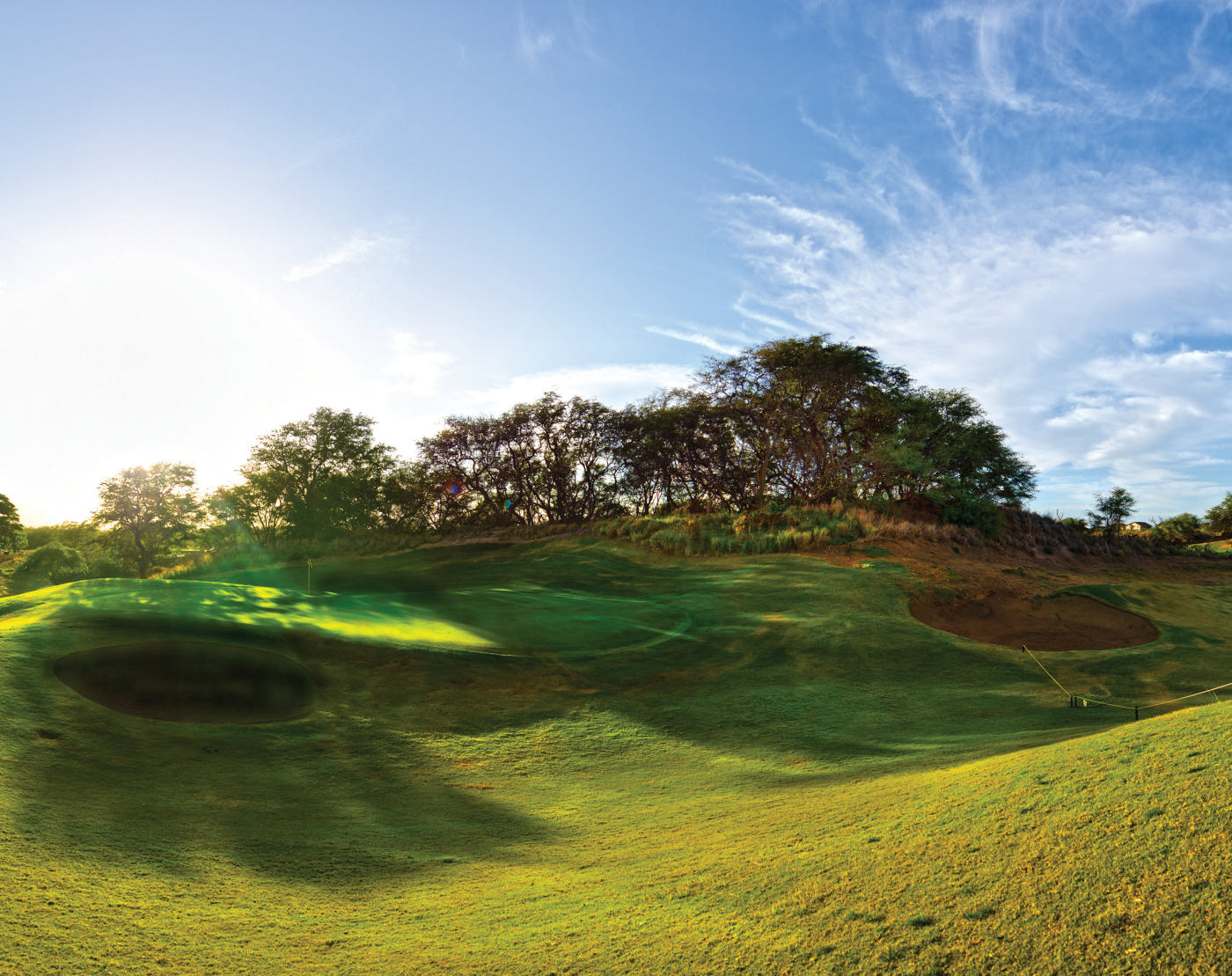
Accolades aside: the purity, challenge, allure, and mystique of The Dunes emanate from more than the decision to minimize the golf course’s impact on the original Kahului isthmus dunes site, but also from how the routing and design of the course’s 18 golf holes go up, over, and around the massive alluvial mounds and gullies, leaving natural elevation changes, unique contours, and an unspoiled terrain to do a good chunk of the heavy lifting.
Robin’s own unique and learned golf course design ideas and methods made The Dunes at Maui Lani such a devilish little par 72 golf course, at only 6,841 yards from the back tees, that all who play it find themselves paradoxically spellbound, often without even realizing they are in a Robin Nelson-inspired trance.
“I play to a 10 handicap,” Robin once confided. “So although I’m usually looking down the middle of the fairway, my eyes are always darting to the rough. This helped me a lot in designing The Dunes to be enjoyable for both the pro and the average golfer alike.”
The golfer never feels forced to play a particular shot, as Robin gives everyone a chance to bail out or play to it safe. He left it to be the golfer’s choice.
“I never intend holes to be birdie or bogey holes. I try to create strategic holes—where risk/reward values are higher on some holes than they are on others,” he explained.
“For example, on hole No. 2, if the tee shot carries the bunkers on the right, the second shot is not blind from the berm long of the landing area on the left. On No. 4 [a short but tricky par 5],” he adds, “it is more obvious: the perfect tee shot rewards the possibility of going for the green in two. On the 5th, the longer the tee shot, the easier the second, but longer gets increasingly more difficult.”
This is golf, and no matter what one’s skill level may be, executing a golf shot properly—not perfectly, just properly—is all that is expected. Where the rubber meets the road, in terms of scoring well, is all about a focus on player strategy, something Robin kept consistent throughout the round: “On the 9th,” he points out, “the tee shot is wide open, and the challenge is on the second shot.
The pot bunkers in the middle of the fairway are bigger than they look, so it appears that the golfer can easily carry them to set up an easy pitch to the elevated green. However, because of the scale of the bunkers and the background of the hill and the blind green, depth perception is skewed, and those bunkers come into play a lot more than one may think.”
Robin drives his risk/reward golfer’s choice point home on No. 12: “The tendency,” he says, “is to hit as long a tee shot as possible, but the best shot is to lay back on the top of the hill. There is a trick to each hole, and the more you play, the more you learn.”
Much like the classic era courses, the front nine heads out, and the back nine heads in. According to Nelson: “Anyone who has seen Ballybunion, Royal County Down, or Shinnecock Hills will recognize a similar look and feel at The Dunes at Maui Lani.”
“It’s not a true links course because we’re in a different climatic zone, and we don’t have the exact same turf conditions. Plus, because of the heat and humidity, we don’t have the fescue grasses and so forth. But in many respects, The Dunes is as close to an authentic links as can be built in Hawaii.”
The Dunes at Maui Lani golf course is also designed with the Hawaiian trade winds in mind, which can blow over the Kahului isthmus, between two island masses, as they funnel around Haleakala and the West Maui mountains, before they turn outward and back at Maalaea Bay and the Kealaikahiki Channel. Each day, as the sun rises and the air warms up late in the morning, these trade winds pick up strength, and Robin Nelson knew there was no need to lengthen the holes, as the winds make many of the golf holes at The Dunes play longer.
Robin Nelson also designed the all-grass driving range with target greens that are akin to what one might see on the course itself, and added a proper practice bunker, chipping green, and a huge practice putting green. He lit the range so Mauians and visitors alike could work on their games well into the night. A terrific resource worth utilizing! The plantation style clubhouse, and PGA-staffed teaching facility are clean, inviting, and appealing places of refuge and staging. The clubhouse’s restaurant, Café O’Lei at The Dunes, is a Central Maui social gathering place.
Adjoining the main restaurant is a moveable wall that opens into a full-fledged banquet facility, replete with a huge lanai where patrons can dine while enjoying the view of the 18th green and fairway, as well as the West Maui mountains.
But the value proposition is in the golf itself, and to that end, as important the layout and the routing of the holes themselves may be, it is the quality of the total experience that endures and what causes us to gravitate to The Dunes.
The Dunes takes the course’s maintenance very seriously, with one of Maui’s best superintendents watching over every detail with the care and attention to the tees and fairways, the playability of the roughs, how the greens hold and roll, and even how the holes are cut all priorities.
From their all-new seashore paspalum greens, which have just matured to produce a “Wow Factor” because of its bright green color, natural striping ability, and smooth playing surface, to the cold towels and smiling faces that are there to lend you a hand with your bags, to the island’s most-winning PGA golf professional and director of golf at The Dunes, the Maui-born and raised Garrett Okamura, few venues on Maui offer so much of it all in a location unlike anything anywhere in Hawaii.
It is why we highly recommend that you add this golf course to your bucket list, and book a tee time while you are here today and experience a real Maui Golf Tradition.